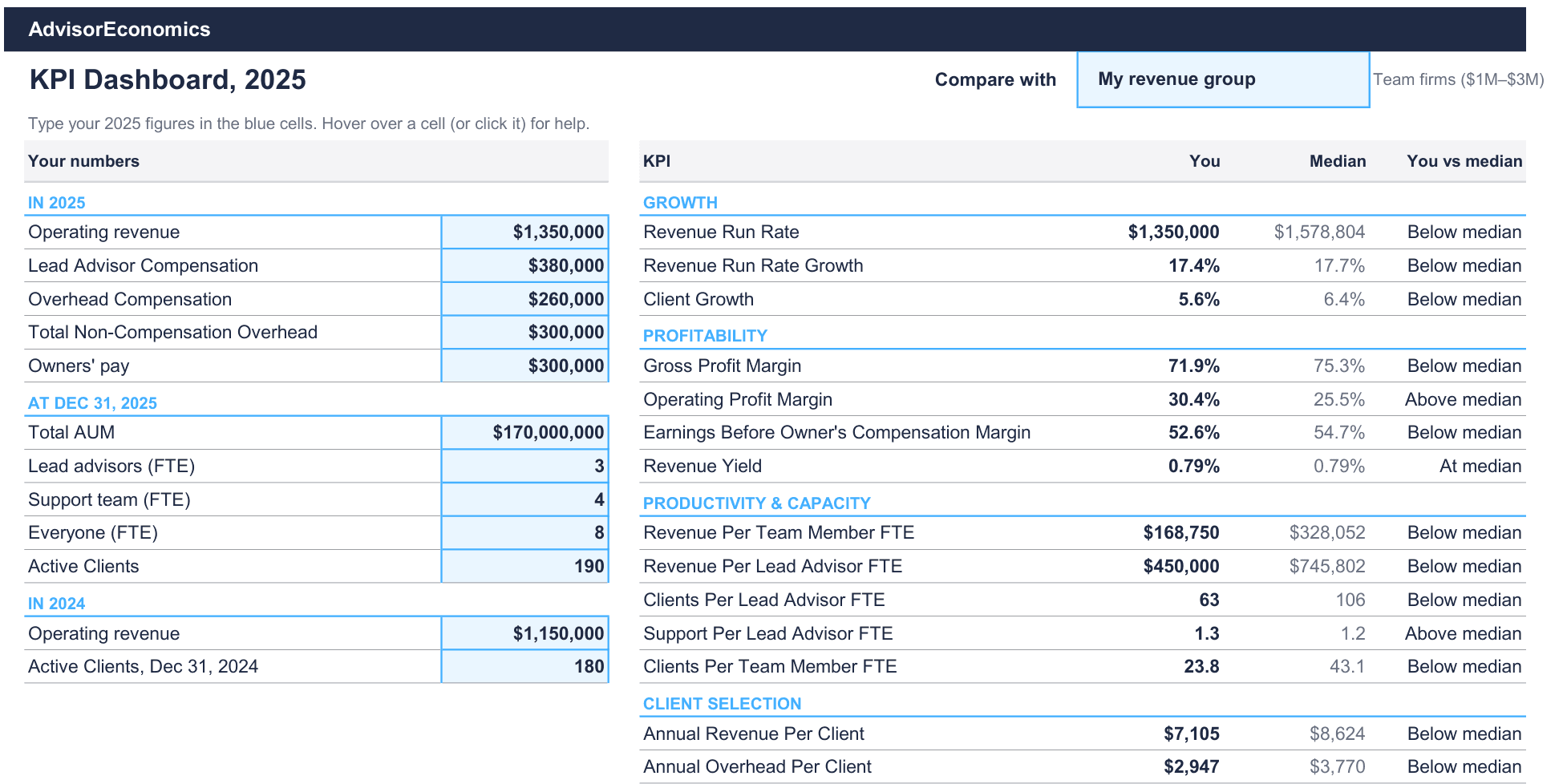
Operating Revenue Per Client is the average amount of revenue your firm receives from each client. Read it against cost per client to see whether fees leave room for margin, ask whether too many small clients are dragging the average down, and check it is high enough to scale: a firm is hard to grow when the average client pays only a few thousand dollars a year. It also explains your capacity numbers: a high revenue per client normally comes with fewer clients per advisor. Use this to benchmark individual clients against your 'average' client, implement service tiers, or identify opportunities to increase revenue through fee adjustments or strategic client transitions. If this is a partial year, it's scaled to a full year.
If your number is low
Small Accounts
Your average client revenue is on the lower end. This could indicate many smaller clients, which increases service drag and limits your firm's revenue ceiling. Consider tiered services, transitioning your least-productive clients, or keeping service deliberately limited to what the fee covers. A high volume of small clients needs more admin support, so make sure your fee schedule charges enough on small accounts to pay for it.
If your number is high
High Value
You're serving high-value relationships with strong per-client revenue. Expect less headroom before capacity, not more: high-fee clients get high-touch service, so each advisor carries fewer of them. Be ready to hire sooner to keep that service level, and watch retention if fees climb too high relative to alternatives.
Further reading
- Using Revenue Per Employee, Client, And Advisor As Productivity KPI Metrics
- How To Gracefully Let Go Of ("Fire") Small Clients As A Financial Advisor
- How Can Financial Advisors Differentiate Their Services Across Segmented Client Tiers?
- Financial Advisor Success Requires Just 50 Great Clients
- What's The Best Way To Raise Your Advisory Firm's Fees?
See your firm's Annual Revenue Per Client, benchmarked against firms like yours.